
Acoustic Detection of the Artemis II Orion Capsule Re-entry
Published:
On April 11, 2026, NASA’s Artemis II Orion capsule splashed down near San Diego at 00:07 UTC — and we heard it.
Interesting shockwave signals were recorded at I57US (33.60585°N, 116.4532°W), an infrasound station of the International Monitoring System (IMS) operated by the CTBTO Preparatory Commission, located near the San Diego coast.
What Was Detected
The signal arrived at 00:12:51 UTC — approximately 5 minutes and 51 seconds after splashdown — with a back-azimuth of 223°, consistent with the capsule’s splashdown zone. The estimated source distance was 120–150 km from the station.
As the Orion capsule decelerated through the atmosphere, it reached Mach 4-5, generating the shockwave that propagated as infrasound and was picked up by the IMS network.
Waveform
The figure below shows the recorded infrasound waveform at I57US. The impulsive signal characteristic of a supersonic reentry is clearly visible, arriving at 00:12:51 UTC.
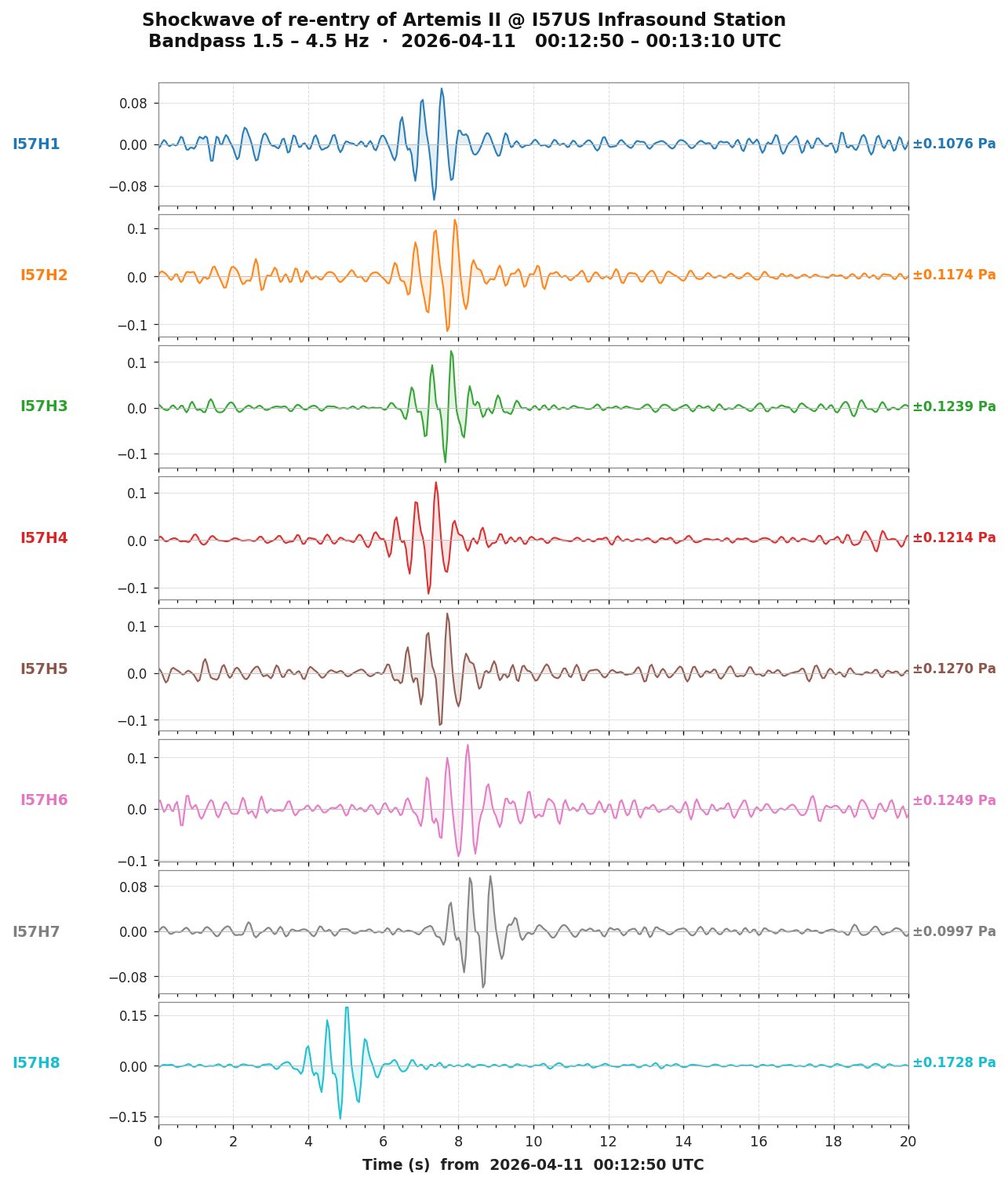 Infrasound waveform recorded at station I57US, showing the shockwave arrival from the Orion capsule reentry on April 11, 2026.
Signal Analysis
The figure below summarizes the full analysis, including beamforming results, back-azimuth estimates, and signal coherence across the I57US array elements.
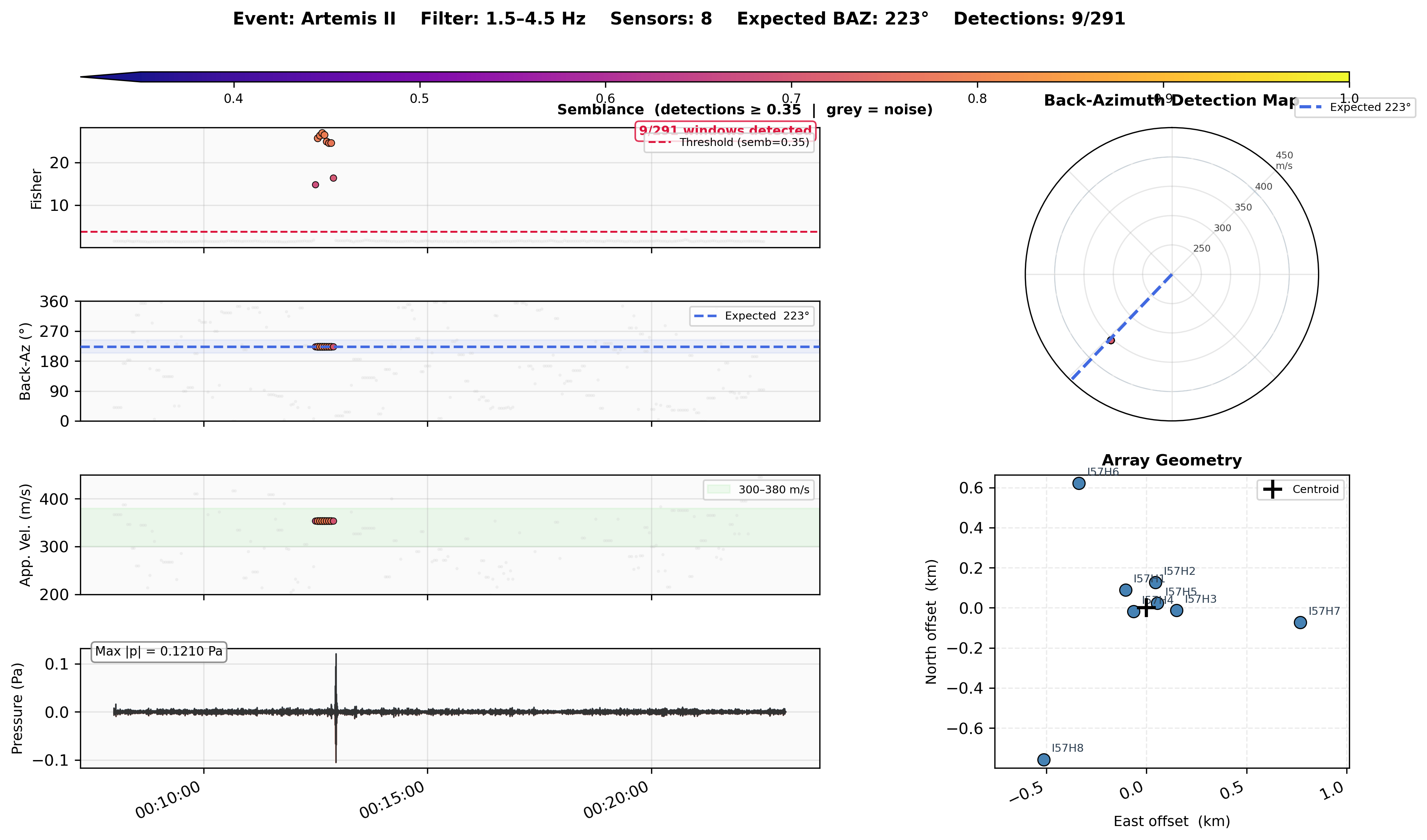 Array processing and signal analysis output for the Orion capsule reentry detection. The back-azimuth of 223° and signal coherence confirm a source location consistent with the splashdown zone.
Significance
This detection adds the Orion capsule to the growing list of interplanetary reentry vehicles acoustically detected by infrasound sensors, alongside:
- Hayabusa (JAXA, 2010)
- Hayabusa2 (JAXA, 2020)
- OSIRIS-REx (NASA, 2023)
Infrasound monitoring is a powerful, passive tool for tracking atmospheric reentries — even those occurring hundreds of kilometers away — and contributes to both space mission science and the verification mission of the IMS network.
Interactive Trajectory Map
The map below shows the splashdown location, the I57US station position, the estimated back-azimuth, and the propagation path of the acoustic signal.
Acknowledgements
Acoustic propagation modeling was performed using InfraGA, an open-source geometric acoustics ray-tracing package developed at Los Alamos National Laboratory (LANL). Atmospheric specifications for the propagation paths were generated using ncpag2s-clc, a command-line client for the Ground-to-Space (G2S) atmospheric profile service developed by the NCPA.
If you are interested in the infrasound data or analysis, feel free to reach out: islam.hamama@nriag.sci.eg